The Board of Directors
Chemed Corporation
255 East Fifth Street, Suite 2600
Cincinnati, Ohio 45202
Dear Members of the Board:
Barington Capital Group, L.P. and its affiliates (“Barington” or “we”) are shareholders of Chemed Corporation (“Chemed” or the “Company”). We are writing to you to share our view that Chemed owns two outstanding businesses whose value is not being maximized, and that the ability (and responsibility) to change this rests in your hands.
Two Outstanding Businesses and a Legacy of Success
Chemed owns two exceptional businesses: VITAS Healthcare and Roto Rooter. VITAS Healthcare is the nation’s largest provider of hospice care, caring for over 23,000 patients daily across 15 U.S. states and the District of Columbia. Roto-Rooter is the leading plumbing and water cleanup services brand in the United States. Through its expansive contractor and franchise network, Roto Rooter covers and serves more than 90% of the United States population and 55% of Canada. Both businesses have genuine competitive moats, generate significant cash flow, and are supported by an exceptionally strong balance sheet.
These competitive advantages have historically produced exceptional shareholder returns. In the ten years preceding Chemed’s all-time high of $650 per share on March 19, 2024, the Company’s common stock appreciated by approximately 636% – a compounded annual return of roughly 20.3%.1 Very few companies can point to a record of this quality, and the Board and Chemed’s Chief Executive Officer Kevin McNamara deserve significant credit for these accomplishments.
Unfortunately, the Company's recent performance no longer reflects either the quality of its businesses or its past legacy of success.
Performance Over the Past Five Years Has Been Disappointing
Despite Chemed’s historical record of shareholder value creation, its share price performance has struggled over the past five years. While the Company's businesses continue to operate in industries with attractive long-term fundamentals, the Company’s common stock has significantly underperformed both its self-selected peer group and the market as a whole over the last one-, three- and five-year periods as shown in the table below:
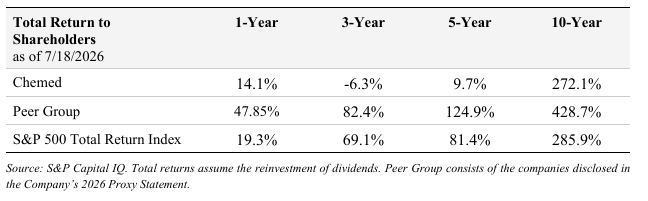
The Company’s own disclosure tells the same story more starkly. The Company’s Pay Versus Performance table in its 2026 Proxy Statement reports that $100 invested in Chemed on December 31, 2021 was worth $82 on December 31, 2025, while the same $100 invested in the Company’s self-selected peer group was worth $182.
The Businesses Have Not Failed; Execution and Oversight Has
We do not believe that the Company’s underperformance reflects structural weaknesses in its businesses. On the contrary, it reflects a gradual loss of operating momentum and an insufficient sense of urgency in responding to changing competitive conditions. Simply put, we do not believe that Chemed has become a weaker company – in our opinion it has become a less ambitious one that suffers from a lack of accountability and effective oversight.
Roto-Rooter is a premier brand serving a large, fragmented and predominantly non-discretionary $100 billion home maintenance market that continues to offer attractive opportunities for organic growth and industry consolidation. Yet despite these advantages, Roto-Rooter's revenue is essentially flat since 2021 and has declined from $949.4 million in 2023 to $897.8 million in the last 12 months ending on March 31, 2026. Roto-Rooter’s adjusted EBITDA has fallen approximately 20.1%, from $249.2 million in 2021 to $199.1 million in the last twelve months ending March 31, 2026 and the adjusted EBITDA margin is down by 6.2 percentage points during that same period. In our view, these results reflect a reluctance to capitalize on the Company's market leadership.
VITAS presents a different, but equally concerning, picture. While revenue increased to $1.6 billion in the last 12 months ending on March 31, 2026, up from $1.3 billion in 2021, the adjusted EBITDA margin fell by 2.1 percentage points during the same period. VITAS’ adjusted EBITDA declined $14 million from $285.5 million in 2024 to $271.9 million in 2025. For the nation’s leading hospice provider operating in the $33 billion U.S. hospice care market supported by powerful demographic tailwinds, declining profitability should not be viewed as an acceptable outcome. We believe the Company should be pursuing a more ambitious strategy to accelerate growth through de novo expansion, disciplined acquisitions and deeper relationships with hospital systems and referral partners.
Meanwhile, corporate expenses have moved in precisely the wrong direction. Between 2020 and the last 12 months ending March 2026, corporate costs increased 29.7%, from $56.6 million to $73.4 million, driven primarily by higher stock-based compensation. Stock option expense alone was $32.7 million in 2025, nearly half the entire corporate cost base and approximately ten percent of the Company’s adjusted net income.
The good news is that none of these challenges are structural or irreversible. Chemed remains debtfree, generates substantial cash flow and possesses significant financial flexibility to invest in growth, pursue acquisitions and return capital to shareholders. We believe that the Company’s recent results are attributable to management decisions, not business limitations. In our view,
Chemed's recent results are the product of management's stewardship of the Company, not inherent limitations of its businesses. The Board can change the Company's trajectory, but only if it is prepared to hold management accountable and demand improved performance.
Our Central Concern: Insufficient Accountability and Board Refreshment
Over the past five years, the Company’s operating performance has fallen far short of what we believe its businesses are capable of delivering. Roto-Rooter’s profitability has declined materially, VITAS profitability has decreased despite continued revenue growth, corporate costs have increased, and shareholders have experienced disappointing returns. It is our belief that the Company has responded to these challenges with insufficient urgency. Management has been slow to acknowledge these problems and slower still to implement a comprehensive plan to address them. In our view, the Board has not exercised the level of oversight necessary to ensure that management responds decisively and is held accountable when performance falls short of the Company's potential.
We believe one important reason for this lack of urgency lies in the composition of the Board itself. The Company’s Board is comprised of nine directors, two of whom (Mr. McNamara and Mr. Hutton) are employees of the Company. The average age of the Board is approximately 70 and the average tenure is approximately 20 years. Five directors have served for 18 years or more, and four have served for three decades or longer: Mr. Hutton (41 years), Mr. McNamara (39 years), George J. Walsh III (31 years) and Mr. Grace (30 years). Corporate governance experts have found that long tenure can diminish the independence of judgment that effective oversight requires for reasons that are well understood: over time, familiarity and shared history make it more difficult for even highly capable directors to challenge management's assumptions, demand meaningful change and hold executives accountable for sustained underperformance.4 We believe that risk has become a reality at Chemed.
This is not a corporate governance issue for discussion in academic institutions. For shareholders, it is a critical concern that impacts the effectiveness of the governing body that they are depending upon to oversee management and ensure that Chemed is operated in their best long-term interests. We do not question the integrity or historical contributions of any director. We do, however, question whether a board on which a majority of the independent directors have served alongside the same chief executive for more than three decades is optimally constituted to constructively challenge management, insist upon accountability, and provide the objective oversight that Chemed requires at this point in its history.
Several aspects of the Board's structure and composition further deepen our concern:
• George J. Walsh III serves simultaneously as Chairman of the Board, Chair of the
Compensation Committee and a member of the Nominating Committee, despite having served alongside Mr. McNamara since 1995. The concentration of responsibility for Board leadership, executive compensation and Board composition in a single director who has served on the Board with the CEO for more than three decades is, in our view, difficult to reconcile with robust independent oversight.
• Mr. Grace has chaired both the Audit Committee and the Nominating Committee while serving on the Board for 30 years. At the 2026 Annual Meeting, he received the highest opposition of any nominee, with approximately 17% of the votes cast opposing his election, while approximately and 12% of the votes cast opposed Mr. Walsh's election.6 We believe these voting results should prompt thoughtful reflection by the Board with respect to these directors, who have each served more than 3.8 times longer than the average director tenure of 7.8 years at S&P 500 companies.
• The Nominating Committee met only once during 2025. The Company's proxy statement also states that the Committee “has no formal policy with regard to the consideration of director candidates recommended by stockholders because it believes such recommendations are sufficiently rare.” As the Committee has broad discretion to consider shareholder recommendations, we believe this disclosure is indicative of a board that has not placed sufficient emphasis on refreshment and shareholder engagement.
• The Board possesses considerable experience in law, finance, nonprofit leadership and consumer marketing. However, we do not believe it includes sufficient recent senior operating experience directly relevant to the Company's most significant strategic opportunities and challenges. In particular, we believe the Board would benefit from directors with substantial experience leading large healthcare services businesses, routebased home services organizations and technology-enabled operating platforms that are reshaping both of Chemed’s markets. These are the areas that will largely determine Chemed's future success.
In our view, a board committed to maximizing long-term shareholder value should be a company’s most demanding constituency. It should expect urgency, insist on accountability and challenge management to deliver results commensurate with the quality of the Company's businesses. Based on Chemed's operating and share-price performance over the past five years, we do not believe the Board has effectively fulfilled this role.
The Company’ Executive Compensation Practices Reinforce Our Concern
We believe the Company’s executive compensation practices reflect the same concerns regarding accountability discussed above. A board that does not effectively align executive pay with performance is unlikely to hold management accountable for subpar shareholder returns.
Executive compensation should reinforce a culture of accountability by rewarding the creation of long-term shareholder value and holding management accountable when expected results fall short of expectations. We believe the Company’s recent compensation decisions send a different message.
During a period in which shareholders experienced disappointing returns and operating performance weakened, Mr. McNamara’s reported compensation remained among the highest in Chemed's compensation peer group. Rather than strengthening the relationship between pay and performance as results deteriorated, the Compensation Committee made decisions that weakened
this alignment.
The Company’s own executive compensation disclosures underscore the disconnect between shareholder returns and executive pay. For the 2023-2025 performance period associated with the Company’s Performance Share Unit (PSU) program, Chemed’s relative total shareholder return ranked at just the 7th percentile of its compensation peer group, resulting in no payout under the relative TSR component of the PSU program. Nevertheless, Mr. McNamara's total reported compensation for 2025 remained essentially unchanged.
Given this, it is no surprise to us that at the Company’s 2026 Annual Meeting on May 18, 2026, shareholders rejected the Company’s executive compensation program by overwhelmingly voting against its advisory vote on executive compensation. More than 61% of the shares voted were cast against this “Say-on-Pay” proposal. Just one year earlier, the Company’s same executive
compensation program received 88.6% support. A reversal of that magnitude – particularly at a company with Chemed’s patient and long-standing shareholder base – is extraordinary.
The likely reasons for this are not obscure. Mr. McNamara’s total reported compensation was $12.9 million in 2025, essentially unchanged from his reported compensation of $12.8 million in 2024 and $12.6 million in 2023 – years over which adjusted earnings per share, adjusted EBITDA and the Company’s share price each declined. In October 2025, Mr. McNamara was granted 58,672 stock options at an exercise price of $443.79, a 45% increase in options over the prior year at an exercise price 26% below it.10 Because these awards are dollar denominated, the decline in the share price increased the number of options granted, resulting in Mr. McNamara receiving his largest option award in years at the lowest exercise price in years. As a result, Mr. McNamara’s reported compensation remained among the highest in the Company's compensation peer group – a peer group selected by the Compensation Committee to benchmark his pay that consists of companies averaging more than twice Chemed’s size based on revenue, enterprise value and market capitalization. His compensation for 2025 also included $258,427 for personal use of the Company aircraft, $121,502 for tickets for Company-paid sporting events and $13,633 for personal use of company club memberships.
Each of these decisions was made or approved by the Compensation Committee of the Board. Each was, in our view, a decision that directors on a board with the requisite independence and culture of accountability would have declined to make.
The Opportunity Ahead
Compensation, however, is not the central issue. It is a symptom. The more fundamental concern is that the Board appears to have become increasingly tolerant of results that, only a few years ago, would likely have been viewed as unacceptable. We believe that culture has contributed not only to an executive compensation program that insufficiently emphasizes accountability, but also to
rising corporate overhead, slowing operating performance and the absence of a clearly articulated strategy to restore sustainable growth at both VITAS and Roto-Rooter. We believe shareholders deserve better.
The good news is that these challenges are entirely within the Board's ability to address. Chemed does not require a new business model. It does not require a highly leveraged recapitalization or a transformational acquisition. It requires renewed focus, stronger execution and a Board that is prepared to challenge management, demand greater accountability and hold itself to the same high
standards that have historically distinguished the Company.
We cannot overstate the meaningful opportunity available for Chemed to create substantial longterm value for shareholders. If Roto-Rooter were to restore its operating margins to approximately the levels achieved in 2020-2024, VITAS were to recover a portion of its recent profitability, and the Company were to implement greater discipline over corporate overhead, we estimate that Chemed could generate approximately $75 million of incremental EBITDA, or roughly $6 per
share of additional earnings. If Chemed were to regain trading multiples more consistent with its historical valuation, our analysis suggests that the Company's shares could appreciate by approximately 35% from current trading levels to more than $700 per share.
Importantly, we believe this value can be created through stronger operating execution, disciplined capital allocation and effective Board oversight, without undue risk-taking. Chemed already possesses the businesses, market positions and financial resources necessary to achieve significantly stronger results. While realizing this opportunity will require a renewed sense of urgency, clear accountability for operating and financial performance, and a steadfast commitment by both management and the Board to long-term shareholder value creation, we believe it is well within the power of the Board to achieve these results.
To help Chemed unlock its substantial value potential, we strongly urge the Board to take the following steps:
Conduct a strategic review of Roto-Rooter and VITAS and formulate plans to improve profitability and accelerate growth. The review should examine Roto-Rooter’s competitive position, its cost structure, and its growth potential through organic investment, partnership and targeted acquisition in a consolidating market. It should also address candidly whether the current multi-business structure has contributed to chronic under-investment in this asset. The Board should then require management to commit publicly to restoring Roto-Rooter’s margin to at least its 2024 level, with specific targets, defined timelines and named accountability. In addition, the plan should develop a roadmap to drive growth at both Roto-Rooter and VITAS.
Impose discipline on corporate costs and capital allocation. We recommend a comprehensive zero-based review of the Company’s $69.5 million corporate cost base and the elimination of non-essential expenses, beginning with the personal aircraft, sporting event and club membership perquisites. We further recommend that the Board adopt and disclose a formal capital allocation framework that tests share repurchases against valuation thresholds and against reinvestment alternatives.
Rebuild the executive compensation program in direct response to the shareholder vote. The Board should conduct structured outreach with its largest shareholders and disclose what it hears; reconstitute the compensation peer group around companies of comparable size; rebalance the equity mix away from dollar-denominated time-vesting options and toward performance awards tied to measurable operating objectives and to relative shareholder return; eliminate the excise tax gross-up and the single-trigger changein-control payment; and bring the Chief Executive Officer’s five-times severance multiple into line with contemporary market practice. This response should be disclosed before the 2027 proxy statement, not within it.
Refresh the Board. We recommend that the Board announce a refreshment program under which at least two directors with tenures exceeding twenty years will not stand for reelection at the 2027 Annual Meeting, and that it will add, before the end of this year, no fewer than two new independent directors with current, senior operating experience in home services, healthcare services or technology. We further recommend that the roles of Chairman and Chair of the Compensation Committee no longer be held by the same individual. Barington would be pleased to assist the Nominating Committee in identifying potential director candidates, as we are aware of several highly qualified individuals.
Conclusion
We appreciate the time that Kevin McNamara and Michael Witzeman spent with us over the past several months, including our meeting in New York on May 19th. We have raised several of these matters with the Company privately, and we wrote to Mr. McNamara on June 3rd setting forth some of our views in greater detail, including recommending a director candidate. We write publicly now because we believe our fellow shareholders have a legitimate interest in these matters.
Barington has a long history of working collaboratively with boards and management teams to strengthen performance, improve corporate governance and create long-term shareholder value. We believe Chemed possesses exceptional businesses and a meaningful opportunity to, once again, create substantial value for all shareholders. We hope to work constructively with the Board to help realize this value and would welcome the opportunity to meet with you to discuss our observations and recommendations in greater detail.
We look forward to your response.
Sincerely yours,
James Mitarotonda
Chairman and Chief Executive Officer
Source: https://static1.squarespace.com/static/68af823f0a03bd38d23dada6/t/6a5f84f8b13ac42073ca3d7c/1784644856291/Chemed+Corporation+-+Letter+to+Board+of+Directors+-+July+20%2C+2026.pdf