Board of Directors
Compass Diversified Holdings
301 Riverside Avenue
Second Floor
Westport, CT 06880
ADW Capital Calls for Immediate Termination / Internalization of the External Manager and a Strategic Review Process of an Orderly Liquidation of Compass Diversified Holdings (NYSE:CODI)
Dear Members of the Board:
ADW Capital Partners, L.P. (“ADW” or the “Fund”) is a substantial shareholder of Compass Diversified Holdings (NYSE:CODI) (“CODI” or the “Company”), beneficially owning approximately 19.3% of the Company’s shares outstanding through ownership of shares and stock options. It has been almost five months
since our last public communication with the Company. Over those same five months, we have had the luxury of learning a great deal more about the Company’s assets, the history of CODI, and the ecosystem governing it. In summary, we have walked away from this period more excited about the assets the Company owns and their values, and increasingly frustrated over its governance failures. We remain 100% convinced that the Board needs to immediately commence a strategic review so the Company’s shareholders can receive the benefit of that value.
We have tried to engage constructively with the “independent” Board and have been aghast by their behavior. It is our belief that certain members of the Board and management purposely obfuscate e-mails and other communications with ADW, the Company’s largest beneficial owner, to protect their own self-interest. They promise meetings with certain individuals who never show up, and generally claim they are working towards value maximizing outcomes; yet we see no evidence and no signs of this progress either in action or in the Company’s share price.
In a most recent Zoom meeting with a fraction of the Board, we spent approximately 45 minutes explaining how a full internalization of the external manager and carry vehicle could create $50 to $60 dollars of value per share through a sequencing of asset sales to streamline the Company alongside aggressive share repurchases. Subsequent to that conversation, there was correspondence from their attorney to ours which said that the Board was uncertain what we had been asking for even though we had spent months communicating this to investor relations and through private e-mails to board members. We have all the receipts.
So, the question is why do the board members behave like this? We believe this Company and Board is among the most corrupt and conflicted group of individuals we have ever experienced in our professional careers. The conflicts as detailed below demonstrate the motives that certain board members have to maintain the status quo and to ignore strategies that would return value to shareholders and operate CODI as an effective and proper public company.
But to understand the conflict and corruption today, one must understand HOW CODI CAME INTO EXISTENCE?
The story starts with the death of Torben Karlshoej – the “TK” of Teekay Corporation (NYSE:TK) and Teekay Tankers (NYSE:TNK) in 1992. It is our understanding that Torben died young and without a will which, in our minds, created the powder keg for the multi-generational institutional grift that ensued. We believe Torben’s brother, Axel, created the Kattegat Charitable Trust out of Torben’s estate to serve as a launching pad with a pool of capital for various ventures which created fee revenue that would flow through to various other beneficiaries including members of the Karlshoej family, Joe Massoud (Founder of CODI), and Sean Day (Former Chairman of CODI and Teekay). It is our understanding that Sean Day, the former chairman of Teekay, got a GP stake in the external manager (Compass Group Management “CGM”) in exchange for his help “founding” Compass pre-IPO. We have never seen the CIO of a college endowment for example get a GP stake in a hedge fund for allocating those “charitable” funds. No conflict? We also would note that various members of the Karlshoej family appear to be employed by Anholt, an entity setup by Joe Massoud to extract fees from the charitable trust after he was kicked out as CEO of CODI for insider trading and subsequently banned from the securities industry. Let’s not forget that Joe traded in a company that CODI itself was under NDA with. This grift and rule breaking seems to be in the very DNA and pervades every orifice of CODI’s origin story.
When Joe Massoud’s attorney reached out to us trying to “smooth the waters” and tell us to direct our concerns to the management of CODI instead of directly to Joe, the facts became clear. He told us Joe had nothing to do with the external management of CODI (to feign optics for his securities ban likely) even though he sat on the ground floor of the same two floor office building in Westport, Connecticut and retained material economics in the Registered Investment Adviser/Carry vehicle that was managing CODI – Compass Group Management and Sostratus.
According to SEC records, Joe attempted in 2025 to get relief from his securities industry bar and be allowed to re-enter the business of providing investment advice. Why was Joe trying so hard get his ban lifted from the securities industry He said it was to further fund his charitable endeavors but we think it was to come back to CODI as CEO “to get what he was owed”. Or did he ever “actually leave?” When we asked the attorney (who also appeared to represent Teekay / Kattegat) if we could discuss the future of CODI given they were the largest shareholder of CODI at the time, he said they had no interest. We found this odd. The Company went public at $15.00 and at the time we spoke it was maybe trading half of that value after 20 years – why would they not have an interest in discussing value maximizing strategies? The only capital provider who behaves like that is one that is non-economic and is being “raided by agents”. In our minds, this type of behavior and ecosystem of grift is truly “The CODI way.”
But this tells the story of how CODI was formed and the people involved in the formation, but it doesn’t tell you why this ecosystem of grift hasn’t been unwound.
We know from the most recent MSA Amendment that it is not that expensive to remove the external manager from the Company. While there are many variables that are unknown to us, we believe the total cost to remove the manager is likely in the low 10s of millions of dollars to get back an approximately 30 million dollar management fee stream. We don’t often see many of those type of return opportunities come around. The Board appears to believe they cannot terminate the manager because the carry vehicle is embedded in the Company’s by-laws. The short answer is they can and the two vehicles were purposely separated in 2013, shortly after Joe left the Company – apparently due to his securities ban and to ensure Joe and his team could never get kicked out. Prior to the separation, when the manager was terminated the Company could have paid the termination fee and an accrued liability for the carry and the result would be that the Company would be “free of all future fees.” Coincidence? The board did not take this decision to a shareholder vote and it is our understanding that a number of people voting on this separation were owners of the manager and directly benefited from the separation. In fact, the SEC corresponded with the Company and asked for additional disclosure around the identities/ownership of these entities.1 Shouldn’t
this have been taken to a shareholder vote given the gravity of this transaction? Did the people who owned the entities recuse themselves from this vote? There is clearly a lot of ambiguity around this transaction and it is not abundantly clear to us that it couldn’t be reversed.
As mentioned previously, in our most recent discussion with some of the Board we proposed entering settlement discussions with the external manager to internalize both the external manager and carry vehicle for a sum that would cost CODI up to $100 million but would likely unlock well in excess of a billion dollars of value to shareholders. We explained that once this was achieved the Company would have no reason to trade at a discount to our analysis of the NAV on 2027 numbers of approximately $33.00 and might in fact trade at a premium with the appropriate board and governance changes. See below for our updated analysis of the NAV:
1https://www.sec.gov/Archives/edgar/data/1345122/000000000014018845/filename1.pdf
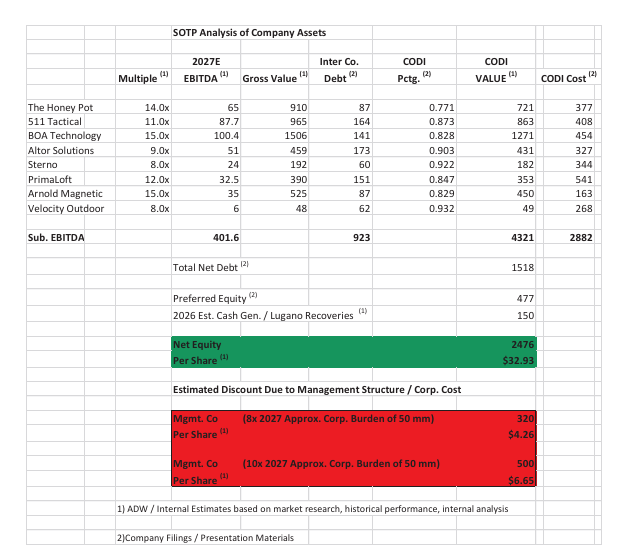
But we have not answered the un-asked question. Why is this Board of eight directors, seven of which are described in filings as “independent,” unwilling to engage constructively to narrow such a significant valuation gap to fair value. The most recent trading price of $9.86 is significantly less than the ~$33.00 value above. In fact, our estimates don’t contemplate much improvement in CODI’s underperforming assets either or opportunistic share repurchase. The simple answer is the vast majority of this Board IS NOT TRULY INDEPENDENT. Below we will go through all the conflicted Board Members and why they have an interest in protecting the status quo:
Larry Enterline (Chairman and Former CEO of FOX Factory):
Larry, who appears very independent, is actually the most compromised. Larry is the living embodiment of the American Dream. Larry was the CEO of a staffing company called PGA in the early 2000’s that Elias Sabo (CODI CEO) and Joe Massoud were on the board of, rescued, and recapped. Larry seems to have been retained after almost bankrupting that Company and got re-equitized in a variety of the surviving entities, ultimately making his first bundle when Comsys Partners was sold to Manpower. Post the Comsys sale, Larry immediately was put into Fox Factory where, by our calculations, he made enough money that he likely has a centi-million-dollar net worth. So, the obvious conclusion to us is that Joe and Elias are almost entirely responsible for Larry’s entire net worth. Maybe he thinks he paid it forward by buying $500,000 worth of diamonds at Lugano (which was detailed in one of the Lugano lawsuits)? Let us also not forget the recent interview Elias gave for National Mentoring Day where he was quite effusive about Larry and his impact on his career.
How could Larry the justify taking money out of Elias’ pocket after Elias put so much in his? Independent? Absolutely NOT!
Heidi Locke Simon (Chairman of TK and TNK, member of Audit and Comp at CODI, Harvard Business School (“HBS”) ’93 Section D):
Heidi is quite possibly the most conflicted “independent” director we have seen in our careers. Heidi is a very sad story. Heidi lost her husband in late 2010 and subsequently began a cross-country affair with a married man (who had young children of his own) and who lived conveniently a few miles away from Joe Massoud and CODI Headquarters in Westport. After a few years of long distance and a new child out of wedlock, Heidi moved to CT with the new baby and her teenage daughter to “destroy someone else’s life and family” as it was retold to me. It appears a few years after Heidi “left” her job at Bain she seemed to be in need of money. How convenient? “Big Joe Massoud” as he was known at HBS was there to save the day. Heidi joined the boards of Teekay and assumed the chairman role after Sean Day resigned. It was at this time Heidi also joined the board of CODI. From what we have researched, there was not a traditional full search ran; she just showed up to replace Sean. Coincidence? No. Sometime in this process Heidi was also retained as a consultant to Kattegat Trust. While we can’t calculate how much money she is making from Kattegat, between the 3 public boards and the private consulting role she looks to be earning millions from the Teekay / CODI complex. Heidi also sits on the comp and audit committee that are integral in negotiating the MSA / calculating comp. How can Heidi render a fair opinion on Joe’s comp when Joe “saved” her in her time of need? It appears he’s determining her comp and she’s determining his. Is this a coincidence? I think not. To our way of thinking, Heidi clearly has shown highly unethical and low integrity behavior through other decisions she has made. But Heidi seems committed to defending her former HBS ’93 classmate. Good luck finding another board or husband for that matter, Heidi!
Eugene Kim (Member of Audit and Comp at CODI, HBS ’93 Section D):
Eugene does not even have a LinkedIn profile, but we spoke to some of his former employers. Eugene was described as someone of reasonable intelligence but somewhat “lazy.” Eugene also was appointed very quickly after Alexander Bhatal resigned. It appears not much of a process was run and maybe Eugene was looking for money given he seemed to not be generating much revenue at his Compass LKL partners.
https://find-and-update.companyinformation.service.gov.uk/company/OC400460/filing-history?page=1
It might also be convenient that he was Joe’s classmate at HBS graduating in ’93 also Section D. Again, this is not a coincidence. Two out of the three members of the comp committee negotiating the MSA are Joe’s business school buddies.
Harold Edwards (Chair of Comp at CODI, CEO of NASDAQ:LMNR):
Harold Edwards may be “independent” if you can consider someone who has been on the board of a Company for 20 years that’s gone nowhere independent. Harold has a great suntan (burn) and seems to be interested in collecting fees and playing tennis. We hear he’s actually pretty good at tennis but also seems to find himself associated with companies that have gone nowhere. Limoneira, the Company he is the CEO of is also DOWN OVER THE LAST 20 years! Is that the only thing he has in common with CODI? No. Harold owns around $3 million in LMNR, yet has earned approximately $17 million in compensation over the last 10 years as the stock has declined.2 It is also our understanding that Harold cut deals to earn special transaction bonuses in connection with asset sales. Harold seems to be used to the “agent” life and is the perfect chair for the comp committee.
Elias Sabo (Member of the Board and Principal owner of CGM and large
owner in Sostratus)
Elias has a close personal relationship with Larry Enterline as evidenced above. Elias also used to be an owner / member of a racing team and built a ~$70 million dollar home:
Elias’ big appetite for risk and spending we believe landed CODI in a “ditch.” Post Elias joining as CEO, the Company got significantly more leveraged culminating in a multi-hundred-million-dollar loss funding Lugano in his backyard. Elias like Larry was a frequent customer at Lugano and seemed to have a penchant for spending his generous share of the onerous management fees. With Elias’ expensive habits, we contend that he has no interest in giving up his “retirement” package. While we cannot be certain, we suspect Elias knew more about what unfolded at Lugano and we have been told as much by former employees of Lugano.
The reality we observe about this Company is that it is toxic, conflicted, usurious, and generally just disgusting. The Company facts demonstrate in our opinion that CODI was setup from the very beginning not to create value for shareholders but to destroy it. While the Board and management say that wasn’t the intent, the actions and incentives created that outcome and will continue to do so as long as it is being run externally by managers connected to the Board and to whom those Board members are beholden.
We are demanding the board immediately commence a strategic review and engage us so we can prevent any future value from being destroyed. Our firm is prepared to run our own slate of directors in the upcoming proxy election and also intend to pursue all legal remedies if the Board continues to refuse to do right by shareholders.
Regards,
Adam Wyden
Managing Member
ADW Capital Management, LLC
Source: https://www.sec.gov/Archives/edgar/data/1345126/000119312526305785/ck0000000000-ex99_4.pdf