Flowserve Corporation
5215 N. O’Connor Blvd., Suite 700
Irving, Texas 75039
Attn: Board of Directors
CC: R. Scott Rowe, Chief Executive Officer and President
Amy Schwetz, Chief Financial Officer and Senior Vice President
Dear Members of the Board,
Starboard Value LP (together with its affiliates, “Starboard” or “we”) is a significant shareholder of Flowserve Corporation (“Flowserve” or the “Company”). We appreciate the time that Scott, Amy, and the management team have spent with us.
Flowserve is a great business in a strong industry that has been held back by inconsistent execution. The Company trades at a significant discount to peers – even before accounting for Flowserve’s substantial opportunity to improve margins and earnings. With improved performance, we believe the value creation potential at Flowserve is considerable. The Board of Directors (the “Board”) must ensure Flowserve delivers materially better performance on both growth and profitability. We will track the Company’s progress closely and will not hesitate to hold the Board accountable if Flowserve fails to deliver results commensurate with the quality of its business.
Flowserve Is a High-Quality Business with Increasing Exposure to Powerful Secular Tailwinds Across Reindustrialization, Power Generation, Nuclear, and Energy Security
Flowserve has long been a leading flow control equipment provider, manufacturing pumps, valves, seals, and related equipment that are essential in keeping critical industrial processes running. Its products help customers move, control, and manage liquids, gases, and other materials in applications where reliability, safety, and uptime are paramount. When a critical pump, valve, or
seal fails, the consequences can include downtime, safety risks, urgent maintenance, and unplanned replacement. This mission-critical role supports a valuable installed base, durable aftermarket demand, and long-standing customer relationships.
Historically, however, Flowserve was viewed as a more cyclical oil and gas supplier, with investors focused on the Company’s exposure to energy capital spending and upstream activity. That perception fails to reflect the breadth of Flowserve’s portfolio and the evolution of the business. Today, Flowserve serves a much broader set of attractive markets. Roughly 50% of bookings come from power generation and industrial markets, ~30% from Energy (of which more than 90% is downstream and refining, with only a small fraction tied to upstream), and ~20% from chemicals. 1 This mix should provide Flowserve with a strong foundation in attractive core markets while positioning the Company to benefit from several incremental growth drivers.
Reindustrialization is driving investment in manufacturing capacity, industrial infrastructure, and supply chain resiliency. Power demand is rising meaningfully, driven by electrification, AI, and data center growth, which is resulting in significant investment in power generation capacity and related infrastructure. According to Gartner, global data center electricity consumption is expected
to approximately double from 448 TWh in 2025 to 980 TWh by 2030.
Nuclear energy is regaining importance as governments and industries seek reliable, low-carbon baseload power. According to the IEA, annual nuclear investment is expected to nearly double to approximately $120 billion by 2030, creating a meaningful opportunity for Flowserve.2 Importantly, Flowserve is a leading supplier to the nuclear industry, with content in approximately 75% of operating nuclear reactors globally. Flowserve is already seeing this demand materialize, with nuclear representing more than 20% of the Company’s backlog. Moreover, given the safety-critical nature of nuclear applications, long qualification cycles, and the need for specialized engineering expertise, Flowserve is one of a limited number of qualified suppliers capable of serving critical pump and valve applications in the nuclear market. We believe Flowserve will be the pump and valve supplier of choice for both traditional nuclear and small modular reactor (“SMR”) deployments.
Energy security and independence are also driving incremental investment across both traditional and newer energy systems, particularly as countries and companies look to reduce exposure to geopolitical risks and improve resilience. Industry research firm Wood Mackenzie recently noted that repeated supply shocks, including from the Middle East crisis, are elevating energy security
to “comparable or greater significance than climate policy” in power generation investment decisions, while a Siemens 2025 survey found that 62% of respondents expect future energy systems to rely more on local or regional production than global trade.
At the same time, the chemicals end market — a significant drag on Flowserve's growth over the past several years — appears to be approaching a cyclical trough. BCG estimates global bulkchemical utilization has fallen to ~70-80%, well below the historical norm of ~90%, and Deloitte describes the industry as “nearing the bottom of a capital cycle.”
Taken together, these trends should provide Flowserve with a strong demand backdrop for years to come. That is precisely why the Company’s inconsistent performance is so frustrating. Flowserve should be benefiting from many of the most attractive secular growth themes in industrial markets today. If the Company is unable to deliver stronger organic growth in this environment, shareholders are right to question whether the issue is execution.
Why Hasn’t Flowserve’s Leading Competitive Position Translated into Strong Results?
Despite operating in attractive end markets and serving as a leading supplier into many missioncritical applications, we believe Flowserve has repeatedly failed to deliver the level of performance shareholders expect from a business of this quality. The consequences are clear: over the last decade, Flowserve’s total shareholder return has meaningfully lagged both the broader industrials sector and the Company’s self-selected proxy peer group.3
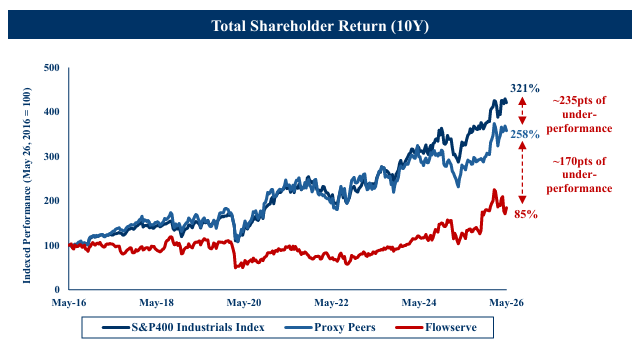
What happened to Flowserve over the last decade?4
I. Flowserve 2016 – 2017: Flowserve Lacked Basic Systems and Processes
In the early-to-mid 2010s, Flowserve was significantly more exposed to upstream oil and gas. The sharp downturn in energy markets heading into 2016 pressured revenue and earnings across the industry. But the market backdrop only explains part of the underperformance. During this period, Flowserve was operating with a decentralized and inefficient legacy model, including more than 50 P&Ls, excessive site autonomy, disparate business systems and processes, and a heavy corporate structure.
“…margins in this business are clearly unacceptable at current levels and require
improved execution.”
– Stifel (October 30, 2016)
“Margins in the traditionally high performing FCD segment were the lowest in a
decade…Outside of just poor execution the only other contributing factor we can think of is the impact of higher raw material costs (mostly steel) in the short cycle distributed valve business (~50% of the segment) not being passed on to customers or mix. What happened to margins in this business?” – Stifel (July 27, 2017)
“The IPD segment is the largest near-term opportunity in fixing internal cost
structure, with the company highlighting healthy gross margins and solid bookings in the backlog, which get diluted by internal execution issues.” – Bank of America (September 27, 2017)
II. 2018 – 2022: Flowserve 2.0 Was the Company’s First Attempt at Operational
Change… But Fell Flat
In 2018, Scott Rowe’s first full year as CEO, Flowserve started to implement Flowserve 2.0, the Company’s first real attempt to drive broad-based operational change. The program sought to significantly reduce the number of P&Ls, develop consistent processes and metrics across the enterprise, improve visibility into operational data, reduce corporate costs, and enhance product and service capabilities to support strategic growth. These were necessary steps, but they did not produce the step-change in execution shareholders expected. While COVID and supply chain disruption clearly affected performance during this period, they do not explain why Flowserve continued to struggle after markets began to normalize and peers showed improved performance. By 2022, operational disruption and repeated cuts to numbers led analysts to describe Flowserve
as being in the “penalty box” for poor execution.
“…we’re more inclined to wait on the stock until execution noise shows signs of
subsiding…” – Citi (February 16, 2018)
“This was disappointing, as it seems FLS is encountering at least one operational issue with each earnings report.” – BMO (May 11, 2018)
“…Flowserve has been in the penalty box for poor execution and repeated cuts to
numbers, while everyone else has been beating, but the demand and orders are there leading us to believe this stock has significant potential upside if they can execute…” – Stifel (July 12, 2022)
“It's hard to imagine execution possibly getting any worse.” – UBS (November 9, 2022)
III. 2023 – 2025: Early Progress Finally Gave Shareholders Reason to Believe
After years of underperformance, Flowserve began to show signs of operational progress from 2023 through 2025. The Company made divisional leadership changes and began implementing an 80/20 program to reduce complexity. These actions finally began to translate into results, and for the first time in years shareholders had reason to believe that Flowserve had turned a corner.
“We think future operating execution/ margin trajectory will be the largest open
question for investors; '23 guidance appears to bake in margins still below 2020/ pre covid levels, suggesting potential upside, although we expect the path to sustained LDD+ profitability will remain a show-me story for most.” – UBS (February 21, 2023)
“FLS appears to be turning the corner on execution issues that have muted
performance over the past few years...we like the trajectory but need to see continued margin execution before getting more constructive.” – Morgan Stanley (May 3, 2023)
By the end of FY25, Flowserve appeared positioned to move from recovery to acceleration. In connection with Q4 FY25 earnings, the Company introduced long-term targets calling for mid single-digit organic revenue growth, approximately 20% adjusted operating margins, and a double digit adjusted EPS CAGR by FY30. Management’s confident commentary during its Q4 FY25 earnings call gave shareholders reason to believe Flowserve was finally positioned to accelerate,
with management emphasizing a healthy project funnel, good line of sight into growth, and positive momentum entering 2026.
“The project funnel for 2026 looks really healthy. And so we've got a good line of sight in terms of the ability to grow this business.” – CEO Scott Rowe (Q4 FY25 Earnings Call)
“Given our progress to date and positive momentum entering 2026, we are confident our strategic areas of focus will provide the opportunity to drive growth and deliver increasing shareholder value for years to come.” – CEO Scott Rowe (Q4 FY25 Earnings Call)
IV. Today: Flowserve’s First Quarter Results Rekindled Longstanding Concerns about Execution and Credibility
Q1 earnings results should have validated that confidence. Instead, they revived the same concerns about execution, visibility, and credibility that have weighed on Flowserve for years. Flowserve reported negative 10.5% organic revenue growth, meaningfully below peers, underscoring that the Company is not converting its strong market position and secular tailwinds into the level of growth shareholders should expect.5 While we acknowledge there are end-market, geographic, and product mix differences between Flowserve and its peers, Flowserve is an extreme
outlier.
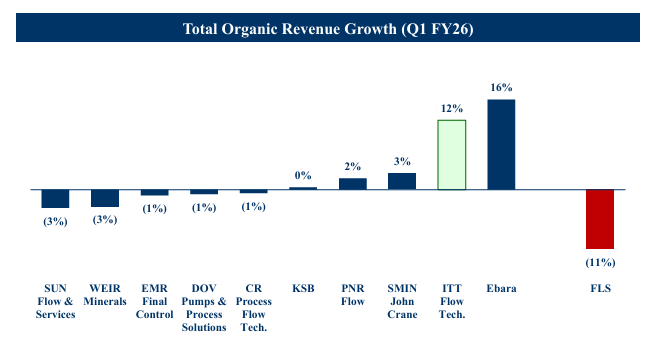
The poor results, lack of clarity around the drivers of the shortfall, and confusion regarding one time adjustments to EPS, have rekindled concerns that management lacked sufficient visibility, failed to communicate key variables clearly to investors, or simply didn’t execute. None are acceptable. Sell-side commentary underscores the extent of the credibility issue.
“…we believe there were some tactical communication errors this Q that put the shares in a tough position for now as investors fear future cuts.” – TD Cowen (May 1, 2026)
“Many have long memories of FLS where earnings disappointments often happened and will be quick to remember that and forget the more recent track record. The miss ex Middle East does look odd in contrast to the confidence displayed post 4Q…” – TD Cowen (April 29, 2026)
“To be sure, we had previewed FLS a bit cautiously given this higher exposure, but
the numbers came in below even our own expectations…orders were down 6% year
over year and would have been negative even without the estimated Middle East impact. Overall organic growth was down 10% (down 8% ex. Middle East), which is notably worse than our expectations of closer to flat organic growth.” – UBS (April 29, 2026)
Unfortunately, the Company’s post-quarter explanations seemed to have exacerbated investor concerns. Following analyst inquiries, management pointed to several factors that contributed to the weak first quarter, including: (i) an internal expectation for an approximately 4.5% organic revenue decline in Q1, driven by a tough prior-year comparison and SKU rationalization associated with the 80/20 program; (ii) an approximately 200bp headwind from the Middle East;
and (iii) a weak start to January and February, particularly within the Company’s maintenance and repair business. This was particularly exasperating, as the biggest driver, management’s ~4.5% organic decline expectation going into the quarter, should have been easily knowable; yet, in the absence of quarterly guidance from management, not a single sell-side analyst had modeled this
decline.
Even giving management credit for these explanations, the underlying performance remained weak – adjusting for the Middle East headwind, the tough prior-year comparison, the 80/20-related SKU rationalization, and other one-time items, the implied Q1 organic revenue growth run-rate was still approximately negative 3.8%.6 While management expects some improvement in Q2 – the Company has guided to approximately negative 4.0% organic revenue growth in Q2, which includes another 400bps of headwinds (comprised of 200bps from the Middle East and 200bps from the 80/20 SKU rationalization) – the underlying Q2 run-rate just gets back to approximately flat organic growth.
Flowserve’s Operational Underperformance Has Created a Significant Margin Gap
While improved organic growth is one driver of value creation, we believe the opportunity to drive outsized margin expansion is equally important. We appreciate that Flowserve has finally started to make some recent progress on margins, but this needs to be looked at in a longer-term context. Over the last decade, Flowserve’s flow control peers generally delivered meaningful operating
margin improvement, with the peer median expanding by approximately 500bps.7 By contrast, Flowserve’s adjusted operating margins declined over the same period.
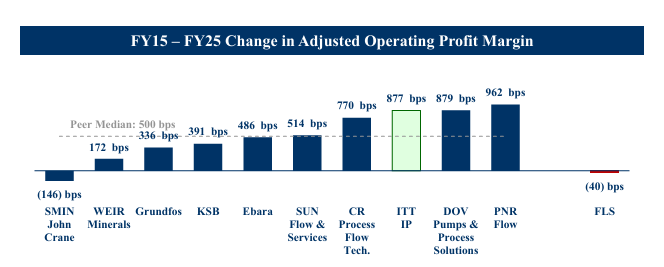
This persistent margin underperformance has not gone unnoticed and reinforces the market’s long standing concern that Flowserve’s margin gap is driven by execution.8
“Over time, we've seen little improvement, and the gap today is much wider than it
was a decade ago.” – TD Cowen (January 16, 2025)
That gap is significant today, with Flowserve’s adjusted operating margins trailing its peer median by more than 500bps.9
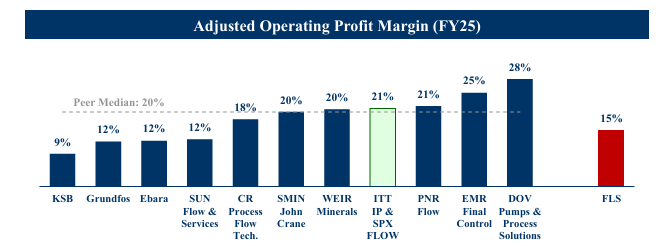
We believe the Company has many of the characteristics that should support a meaningfully stronger margin profile, including highly engineered products viewed by customers as best-in class for mission-critical applications, a valuable installed base, a robust aftermarket business, and scale that is comparable to, if not greater than, most of its peers in the pumps and valves market.10
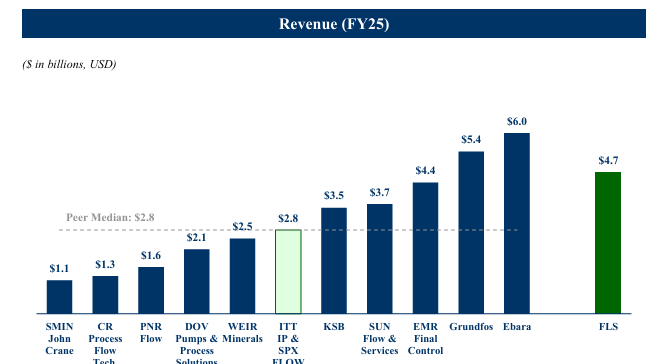
We believe the margin gap stems from weaker historical operational execution rather than structural differences.
“Taking a broad look at FLS's portfolio vs. ITT's…we can see the overarching
similarities suggesting that vastly different margin profiles likely shouldn't exist on a structural basis. There will be friction points certainly, but overall, the portfolios are likely more similar than different. Seals (with attractive aftermarket characteristics) are an area of differentiation, however.”11 – TD Cowen (January 16, 2025)
The margin divergence versus ITT, despite the portfolio similarities highlighted above, reinforces this point: Flowserve’s margin gap is not simply the result of portfolio differences, but rather appears to reflect company-specific issues around operational execution and consistency.
Flowserve Is in the Early Innings of Its Operational Turnaround, with the Most Significant Work Ahead
Flowserve has started to take some important early steps, including simplifying the organization, improving data collection, strengthening systems and processes, and putting new divisional leadership in place. We appreciate that many of these systems and processes were not in place historically and hope these changes have helped establish a stronger operational foundation. While these actions were necessary, they should not be mistaken for sufficient progress. This next phase of operational improvement will include meaningful footprint rationalization, plant productivity improvements, supply chain optimization, better commercial execution, more dynamic pricing, and tighter cost discipline across the Company. These more complex operational changes will require significantly stronger execution to translate into the margin improvement the business should be capable of delivering.
Flowserve’s FY30 Targets Are a Step in the Right Direction, but Should Be Viewed as an Interim Milestone Rather than the Full Extent of the Opportunity
We are encouraged that the Company has established FY30 targets, including (1) a mid-single digit organic growth CAGR from FY25 to FY30, (2) approximately 20% adjusted operating margins, and (3) a double-digit adjusted EPS CAGR from FY25 to FY30. We view all three of these targets as highly achievable. Underlying end-market demand and the mega-trends discussed earlier should support at least mid-single-digit organic revenue growth. If anything, the potential rebuild, repair, and redundancy opportunity in the Middle East should provide upside to the Company’s long-term organic revenue growth target. With improved working capital management, we believe Flowserve’s free cash flow generation potential should allow it to repurchase a substantial portion of its share count by FY30, supporting a strong double-digit EPS CAGR. Most importantly, 20% adjusted operating margins by FY30 would only bring Flowserve to roughly where peers are today, leaving room for further improvement. We believe 20% should be viewed as an intermediate milestone rather than the full extent of the margin opportunity.
Peers are not standing still.12 ITT’s Industrial Process business, for example, is at approximately 21% adjusted operating margins today and has set a FY30 target of 25%, underscoring that materially higher margins are achievable in this business. Looking more broadly, while flow control peers on average are already at approximately 20% today, they are expected to reach a median margin of 23% by FY28, meaning Flowserve is targeting by FY30 a margin level that peers have already achieved and are expected to exceed meaningfully over the next several
years.
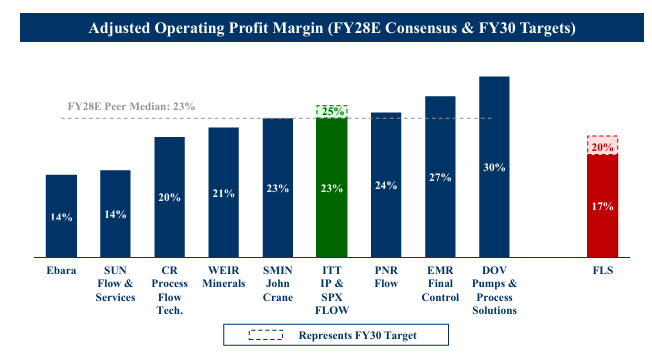
We believe more aggressive action is needed to accelerate operational improvements and Flowserve must skate towards where the puck is going, not where it is today.
Flowserve Must Deliver More Consistent Performance to Win Back the Trust of Shareholders
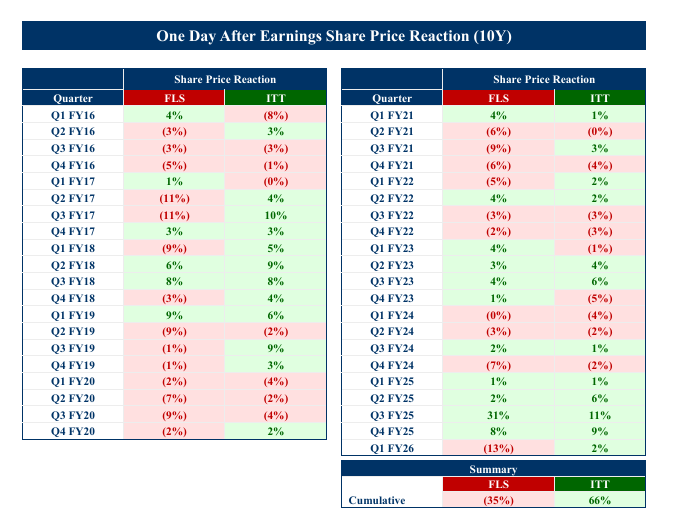
For an example of how consistent execution is rewarded by investors, Flowserve needs to look no further than ITT. Over the last ten years, Flowserve’s quarterly earnings reports have too often reinforced investor concerns about execution, resulting in cumulative post-earnings share price reactions of approximately negative 35%. By contrast, ITT’s post-earnings reactions were cumulatively positive 66% over the same period.13 This combined ~100 percentage points of underperformance on earnings explains a significant portion of Flowserve’s long-term share price lag.
Flowserve’s Current Valuation Reflects Deep Skepticism about Execution
The good news for shareholders is that Flowserve’s current valuation already reflects a highly discounted view of the Company’s expected earnings – the market clearly does not believe management that the factors that impacted Q1 were transitory and the Company will return to growth in H2.14 Consensus EPS is at the low end of management’s guidance range, and the Company trades at a steep discount to peers, suggesting the market is pricing in significantly lower numbers. For example, even if we take an extremely punitive approach by annualizing Flowserve’s disappointing Q1 EPS run-rate, excluding one-time items, the Company’s implied multiple would still be roughly in line with peers.15 In other words, Flowserve does not need aggressive, or even reasonable, earnings assumptions to justify its valuation – the Company could show no improvement from its disastrous Q1 and still be trading at a fair multiple, and it offers meaningful upside if management executes on its full year guidance.
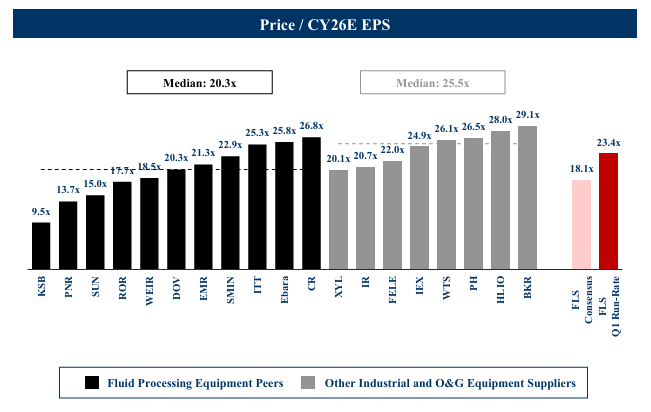
The best part is that FY26 should represent a starting point for significantly accelerated margin improvement and earnings growth! If it does not, things need to change.
Better Execution Would Unlock Significant Shareholder Value
Flowserve’s FY30 targets provide a clear path to meaningfully higher earnings power. If the Company executes on its plan to deliver mid-single-digit organic revenue growth, expand adjusted operating margins to at least 20%, and improve free cash flow conversion, and maintains disciplined capital allocation, Flowserve should generate meaningfully higher adjusted EPS by FY30. Assuming Flowserve achieves its long-term targets and allocates 100% of excess free cash flow to share repurchases, the Company is currently trading at just 8.9x pro forma FY30 adjusted EPS.16 If Flowserve were to expand adjusted operating margins to 23% by FY30— still below where best-in-class peers are expected to be by that time — we estimate that its implied pro forma multiple would be even lower, at 7.4x.
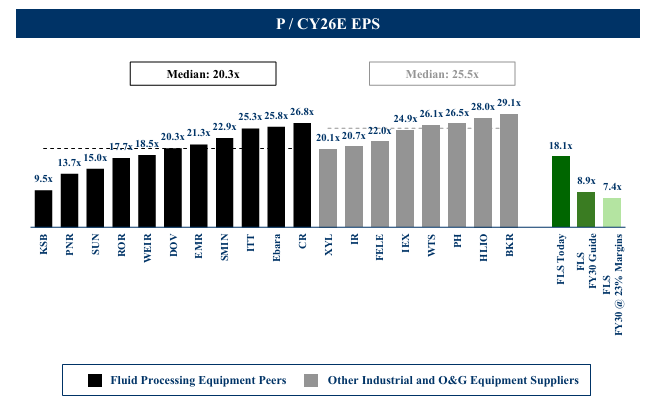
We believe Flowserve can achieve these targets, if not exceed them, and shareholders should expect the Company to deliver. If Flowserve executes, this would imply substantial upside from current levels. Based on our extensive due diligence and discussions with leading industry executives, we see no structural reason why Flowserve cannot achieve margins in line with best-in-class peers. We hope that management can deliver on this remarkable opportunity, but it is the Board’s responsibility to ensure Flowserve has the right leadership in place to
realize the value available to shareholders.
Shareholders Are Set Up for a Win-Win, but the Board Does Not Have that Luxury
Despite a weak first-half trajectory, Flowserve maintained its annual EPS guidance and only slightly reduced its full-year organic growth guidance. The Company’s full-year outlook requires a steep second-half acceleration. To achieve the midpoint of its FY26 organic growth guidance, Flowserve needs to deliver approximately 8.0% organic growth in the second half of 2026. Management has set a clear expectation for FY26, and we hope this reflects confidence in the business and improved execution. If Flowserve delivers, shareholders should benefit from improved growth and meaningful upside from today’s discounted valuation. Even without meaningful improvement, shareholders are getting a good business at a fair price.
The Board, on the other hand, cannot just wait for execution to improve – it is the Board’s job to oversee the Company and hold management accountable. We hope you as a Board are as confident as management. If not, then figure out how to improve accountability and execution now. If the Company once again falls short, we believe shareholders will expect substantial change. We would fully expect the Board to take decisive action to ensure Flowserve has the right leadership in place.
In either case, shareholders should benefit from a higher standard of performance and a more urgent focus on value creation. In either case, shareholders should expect that the Board will oversee a leadership team that will execute operational improvement that goes well beyond the 2030 targets.
Conclusion
Flowserve has the attributes of a best-in-class industrial company: leading positions in mission critical products, a valuable installed base, a strong aftermarket business, and exposure to attractive and growing end markets. Yet the Company’s margins and overall operational performance fall short of what shareholders should expect from a business with those advantages. The gap between the quality of the business and its current level of growth and profitability remains too wide. This is a great business, and it can do better. We look forward to working with management and the Board to ensure the Company operates better, improves faster, and capitalizes on the very positive trends across your business lines.
Sincerely,
Jeffrey Smith
Managing Member
Starboard Value LP