Knife River Corporation
1150 West Century Avenue
Bismarck, ND 58503
Attn: Brian R. Gray, President and Chief Executive Officer
CC: Board of Directors
Dear Brian,
Starboard Value LP (together with its affiliates, “Starboard” or “we”) is a significant shareholder of Knife River Corporation (“Knife River” or the “Company”). We are writing to share our views on the opportunity to improve Knife River’s performance and unlock substantial value for shareholders.
As we discussed, we invested in Knife River because we believe it is an exceptional business in a highly attractive industry. However, we believe Knife River has failed to realize its potential, resulting in lackluster and, frankly, unacceptable shareholder returns. Yesterday’s announcement is another disappointing setback in what has become a consistent pattern of underperformance. This failure cannot be attributed to the quality of Knife River’s assets or the attractiveness of its markets. The Company owns approximately 1.3 billion tons of aggregate reserves in local markets where scarcity, permitting constraints, and the high cost of transporting aggregates relative to their value create durable barriers to entry and meaningful pricing power.1 Nor can the failure be attributed to a lack of opportunity. At the time of its separation from MDU Resources Group, Inc. (“MDU”) in 2023, management expressly acknowledged that Knife River’s margins were far below those of its peers and committed to closing the gap by leveraging the renewed focus, accountability, and flexibility afforded by its independence.
The record, as set forth in greater detail below, is straightforward: Knife River has fallen further behind its peers since separation, reflecting poor execution and insufficient accountability. We are concerned the Board of Directors (the “Board”) may have relied on management’s claim it achieved a static 15% margin target, which was set at a cyclical low and quickly became meaningless as industry margins recovered, to conclude that the Company’s performance has been acceptable. We want to be clear. Attaining the static and obsolete target of 15% was not progress; measured against the industry, it represented considerable, and unacceptable, underperformance. Since management committed to closing the gap in 2023, peer margins have expanded dramatically, and Knife River has fallen further behind. The profitability gap has widened from approximately 1,053 basis points to nearly 1,400 basis points. Over the same period, Knife River’s stock has meaningfully underperformed and the Company’s valuation discount relative to peers has continued to widen.
We believe the Board must now require management to develop, communicate, and execute a credible plan to achieve at least a 22% adjusted EBITDA margin by FY2029, a target we believe to be achievable based on the levers available to the Company and consistent with the approximately 700 basis point margin gap implied by management’s original FY2025 target. If management and the Board lack confidence in the Company’s ability to achieve these targets, then the Board should evaluate all potential strategic alternatives. We believe Knife River is simply too valuable a business to accept subpar performance. If the Company cannot be operated to the standards its assets and shareholders deserve, the Board has an obligation to determine whether another owner will pay shareholders for the scarcity and strategic value of those assets.
I. Knife River Has Failed to Deliver on the Opportunity Identified at Separation
For years inside MDU, Knife River was managed primarily to support investment elsewhere across MDU’s portfolio rather than to maximize its own performance or value. Separating the business in 2023 was therefore an appropriate and necessary first step toward creating the focus and accountability needed to unlock Knife River’s full potential. At its inaugural Investor Day in 2023, management presented the separation as an inflection point, explicitly acknowledging the Company’s substantial margin gap relative to peers and committing to close it. Management established an adjusted EBITDA margin target of approximately 15% by FY2025 as an initial milestone toward a longer-term target of greater than 20%:
Brian Gray, Knife River President and CEO, 2023 Investor Day, May 18, 2023:
“But as we prepare to spin to become independent, we started looking at our peers. We started looking at ourselves in the mirror as a stand-alone materials supplier that's vertically integrated and realized that we want to do – focus our attention on our margin improvements”
“We're going to remain vertically integrated. We're also – obviously, we are very committed to improving our EBITDA margins. We see a path to get to 15%, approximately 15% by the year 2025… Our entire business model revolves around and hinges on the aggregates that we've got as reserves. We see a path, and you'll hear a lot more about it and how we're going to get to above 20% EBITDA margins long term. We're committed to doing that and maintaining our #1 market position in the markets that we operate in.”
“We have a motivated, highly experienced leadership team with a strong track record of achieving its goals, now laser-focused on executing our EDGE strategy for margin improvement and long-term value creation”
Note quotes are underlined for emphasis. Source: Public company transcripts.
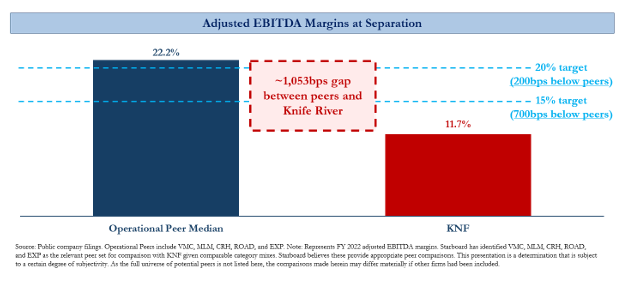
As shown below, the Company’s self-help opportunity was both substantial and readily apparent. At the time of the separation, Knife River’s adjusted EBITDA margin trailed selected operating peers by an astonishing 1,053 basis points.
However, as we believe you are well aware, absolute and static margin targets are an imperfect measure of performance in this industry. Aggregate prices generally rise over time while significant cost inputs, including transportation fuel, are highly cyclical, causing industry margins to naturally fluctuate. As a result, a fixed absolute target can quickly become meaningless because it may no longer reflect the underlying economics of the industry or the level of profitability that should be reasonably expected.
To assess performance properly, Knife River’s original targets should be translated into relative targets, which you likely had internally. At the time of the 2023 Investor Day promises, peer adjusted EBITDA margins were approximately 22%. As shown below, Knife River’s 15% target therefore implied narrowing the profitability gap to approximately 700 basis points, while the longer-term 20% target implied narrowing the gap to approximately 200 basis points.
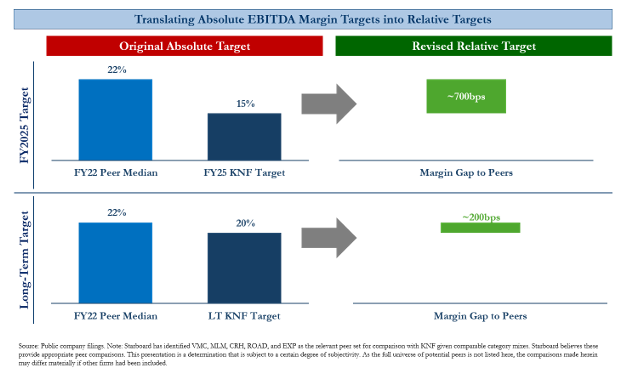
In our view, these relative benchmarks, rather than static absolute targets, provide the appropriate measure of whether Knife River has delivered on the margin opportunity identified at separation. We believe these relative targets were reasonable and remain the proper framework for evaluating Knife River’s performance.
This distinction is particularly important for Knife River because industry margins were cyclically depressed in FY2022 immediately prior to the separation and then rebounded in FY2023. Significant fuel and other input cost inflation had materialized before corresponding price increases could be fully realized, pressuring profitability across the industry. As those pressures eased, previously implemented price increases took hold, driving broad-based margin expansion, as reflected in the peer commentary below:
Tom Hill, Vulcan Materials Chairman and CEO, Q3 2023 Earnings Call, October 26, 2023:
“…where we struggled with unit margins because of inflation and energy last year, we got past that with price, as we predicted. Volumes in the quarter were a little challenged on a same-store basis… but prices were up 10% and unit margins were up over 30%.”
Ward Nye, Martin Marietta Chairman and CEO, Q4 2022 Earnings Call, February 15, 2023:
“As I said in the prepared remarks, an inflationary environment is usually helpful for upstream materials. What's the challenge is when it moves so rapidly and moves in big chunks. And that's what happened in 2022... The difference is now we've caught up with it.”
Jim Nickolas, Martin Marietta CFO, Q2 2023 Earnings Call, July 27, 2023:
“Aggregates gross profit improved 20.7% relative to the prior year period… as strong pricing growth and lower diesel fuel expenses more than offset lower shipments and increased nonenergy-related costs.”
Note quotes are underlined for emphasis. Source: Public company transcripts (Bloomberg).
As industry conditions normalized from FY2022 to FY2023, peer adjusted EBITDA margins increased nearly 400 basis points, from roughly 22% to 26%. Despite starting from by far the lowest margin base, and therefore having the greatest opportunity to close the gap, Knife River improved by only approximately 350 basis points, modestly lagging peers and allowing the gap to widen further. To make matters worse, the divergence only accelerated from there. After the industry normalized in FY2023, peers have expanded margins by approximately another 300 basis points, while Knife River has failed to sustain even its initial improvement and today generates margins below its FY2023 level. The evidence is clear: what was already a substantial profitability gap at separation has become meaningfully worse.
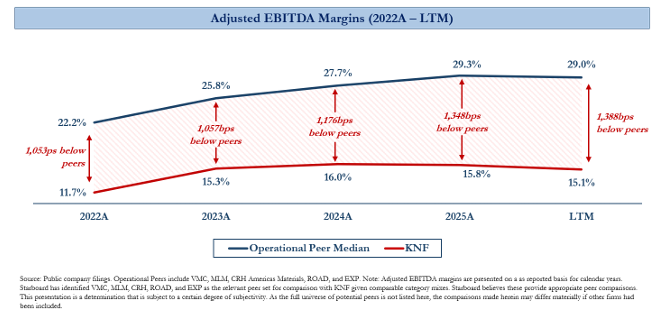
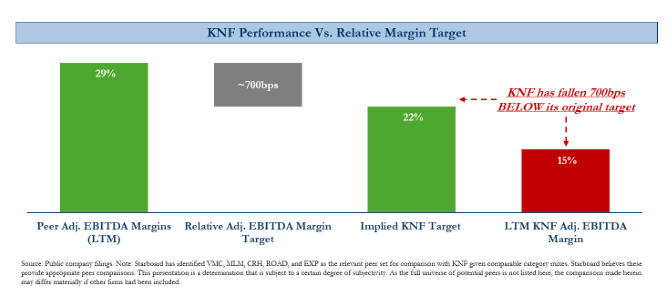
The facts are undeniable: management committed to closing the margin gap to peers, yet that gap has widened materially since the separation. That outcome is unacceptable, and the Board must hold management accountable. Unfortunately, management has repeatedly sought to defend this record by pointing to its achievement of a 15% adjusted EBITDA margin target. That argument is fundamentally flawed because it ignores how peer profitability has evolved. As explained above, the proper measure is relative performance. When management set its initial 15% adjusted EBITDA margin target, peers were at 22%, implying a 700 basis point gap. With peer margins now at approximately 29%, maintaining that same 700 basis point gap would imply a 22% adjusted EBITDA margin for Knife River. That is where Knife River’s margins should be today. At approximately 15% today, Knife River is roughly 700 basis points below the target implied by management’s own original framework. The 15% margin is not evidence of success; it is instead evidence that Knife River has fallen further behind its peers and that the Board and management are comfortable hiding behind a flawed absolute target. Shareholders know better and deserve better.
II. Knife River Has a Clear Path to 22%+ Margins and Significant Value Creation
To address the Company’s lackluster operating, financial, and share price performance, we believe Knife River should formally commit to narrowing its profitability gap to approximately 700 basis points relative to peers, consistent with the goals communicated at the 2023 Investor Day and implied by its original 15% margin target. Based on current peer adjusted EBITDA margins of approximately 29%, Knife River should target an adjusted EBITDA margin of 22% by FY2029, a level that should have been achieved by FY2025. We believe this target is achievable given the substantial pricing and cost opportunities available to the Company. Notably, management’s original plan contemplated narrowing the gap to 700 basis points over approximately 2.5 years. Applying a similar timeframe today makes a 22% adjusted EBITDA margin by FY2029 both reasonable and achievable.
First, Knife River must more fully realize the pricing power of its Aggregates segment. For years under MDU, the Company failed to increase aggregate prices in line with the broader industry, creating a substantial pricing gap by the time of the separation. Although management has since begun raising prices, we believe these efforts represent the bare minimum. Peers have continued to raise prices, and Knife River has failed to close the gap. Relatedly, we fear the Board may be overly complacent by the illusion of absolute price increases without understanding the comparable price underperformance. As shown below, the per-ton price gap between Knife River and its aggregate-focused peers has widened since the separation. This is not good enough. Knife River must do more to recover years of underpricing and realize the full value of its scarce, strategically located reserves.
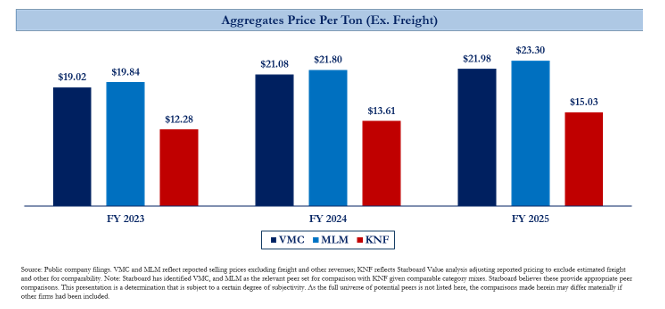
While geographic and product-mix differences explain a portion of the disparity, we believe that more than half of the pricing gap is addressable. The Board should require explicit pricing targets relative to the broader market and hold management accountable for closing the gap. Better pricing tools, clearer accountability and stronger commercial discipline should enable Knife River to recover years of underpricing and more fully realize the value of its scarce, strategically located reserves.
Second, Knife River must rightsize its cost structure. The importance of operational efficiency is well established across the industry. As Ward Nye, Chairman and CEO of Martin Marietta Materials, explained in 2021:
“Pricing has a great future. Now separate and distinct from pricing, though, we're also committed to operational excellence…Operational excellence matters, that together with commercial excellence, makes a big difference. But what this operational excellence gets you? It gets you this. It puts you in the position that we are the clear, low-cost producer.”
Source: Public company transcripts (Bloomberg).
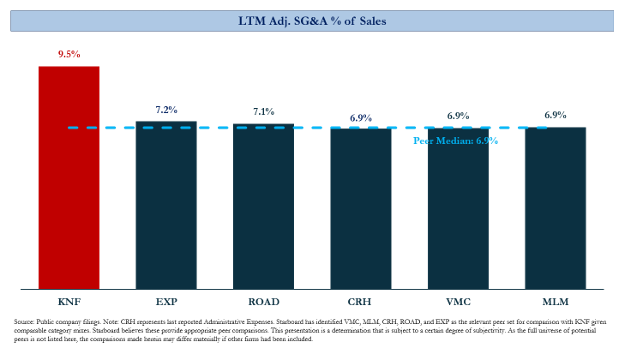
As shown below, the Company’s adjusted SG&A remains materially above peers, indicating a substantial opportunity to reduce both corporate overhead and local operating costs. In a business with attractive incremental economics, excess overhead directly reduces the value created by each dollar of revenue growth.
The Board should require management to establish specific cost-reduction targets, assign clear ownership and report progress against defined timelines.
Taken together, we believe these initiatives provide a credible path to an adjusted EBITDA margin of at least 22% or 700 basis points, relative to peers by FY2029. Achieving this target would drive substantial earnings growth and create significant shareholder value even before any improvement in Knife River’s relative valuation. Further, management had also articulated a longer-term target of greater than 20% margins, which at the time implied operating approximately 200 basis points below peers at 22%. Applying that same relative benchmark today would imply Knife River should achieve margins of approximately 27%, highlighting both the magnitude of the remaining opportunity and how far Knife River has fallen short of the performance originally promised to investors.
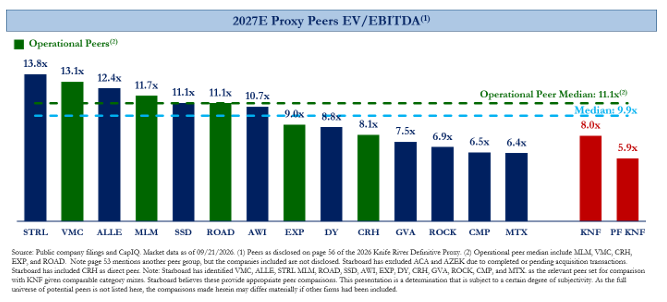
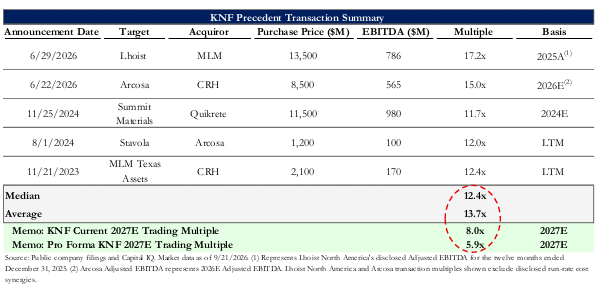
Today, Knife River trades at approximately 8x 2027E EBITDA, a substantial discount to peers. The chart below shows that the multiple premium at which peers have traded relative to Knife River has widened since the separation. In other words, the market has increasingly discounted Knife River relative to comparable businesses, which we believe reflects growing skepticism about the Company’s ability to deliver sustained margin expansion.
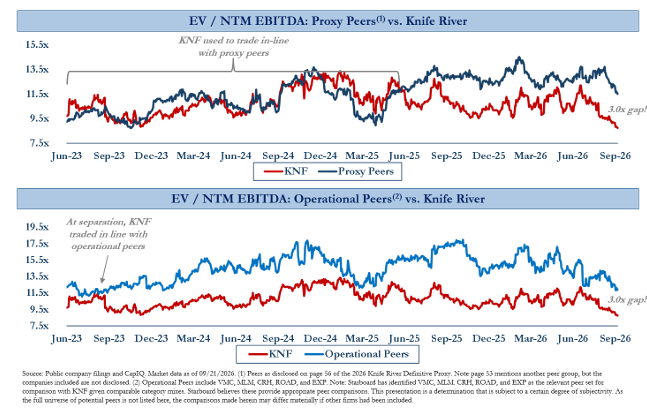
This valuation disconnect becomes even more pronounced when considering Knife River’s earnings potential at a 22% adjusted EBITDA margin, without yet discussing the potential for margins 200 basis points below peers, or 27%. At the current enterprise value, the incremental EBITDA generated at that margin would result in a materially lower pro forma trading multiple, further widening the discount to peers. Meaningful value creation can therefore be achieved through both earnings growth and as well as some normalization of Knife River’s valuation relative to peers providing additional upside.
III. Knife River Is a Strategic Asset
While management must remain focused on closing the operating gap and delivering the earnings potential outlined above, management and the Board should simultaneously evaluate all available paths to maximize shareholder value. These objectives are not mutually exclusive.
Given the extensive permitting requirements and substantial time and capital needed to develop greenfield reserves, recreating a portfolio of Knife River’s scale and quality within any reasonable period would be extraordinarily difficult, if not outright impossible. This scarcity is particularly valuable in an industry where M&A is a core component of capital allocation and leading participants consistently seek to acquire attractive reserves. Importantly, there are few remaining public or private platforms of comparable scale to Knife River. This scarcity is becoming increasingly valuable as the industry’s largest participants grow and require larger transactions to deploy capital in a manner that meaningfully affects their financial results.
Notably, precedent transactions involving comparable assets have occurred at meaningfully higher multiples than Knife River’s current valuation.
IV. Conclusion: The Board Must Ensure Knife River Realizes Its Full Potential
We look forward to engaging constructively with management and the Board. Shareholders should expect a clear plan, defined accountability, and decisive action to address years of underperformance. We are committed to helping ensure that Knife River realizes its full potential for the benefit of all shareholders.
Sincerely,
Jeffrey Smith
Managing Member
Starboard Value LP